Thursday, April 21, 2016

Let's Talk About Malaria!

DID YOU KNOW?
-       3.3 billion people (half the world’s population) live in areas at risk of malaria transmission in 109 countries and territories
-       35 countries (30 in sub-Saharan Africa and 5 in Asia) account for 98% of global malaria deaths
-       89% of the malaria deaths worldwide occur in Africa
-       The World Health Organization estimates that in 2008 malaria caused 190-311 million clinical episodes and 708,000-1,003,000 deaths
-       Malaria is the 5th cause of death from infectious diseases worldwide (after respiratory infections, HIV/AIDS, diarrheal disease, and tuberculosis)
-       Malaria is the 2nd leading cause of death from infectious diseases in Africa, after HIV/AIDS
-       There are over 5 million clinical malaria cases in Ethiopia each year
-       In Ethiopia, malaria is the leading cause for outpatient consultations, hospital admissions, and hospital deaths
-       There is malaria in 75% of the total country of Ethiopia, with 68% of the population at risk
-       Transmission in Ethiopia occurs mostly from September to December
(Source: Stomp Out Malaria Tool Kit- Peace Corps Ethiopia)

10 FACTS ABOUT MALARIA:
-       Malaria is a life-threatening disease
-       Malaria is spread from person to person by the Anopheles mosquito, which bites at night time
-       Anyone can get malaria—boys and girls, adults, children, and babies
-       Malaria is preventable
-       Sleeping under an insecticide-treated mosquito net every night is the best way to protect yourself from malaria
-       Symptoms of malaria include: fever, chills, sweats, headaches, loss of appetite, pain in the joints, diarrhea, nausea and vomiting, and convulsions
-       You can find out if you have malaria with a 20 minute RDT (Rapid Diagnostic Test)
-       Malaria is curable. A medicine called ACT can be taken to treat and cure malaria
-       Seek medical attention at the first sign of malaria for testing and treatment
-       Malaria can be eliminated. Other parts of the world have already eliminated malaria
(Source: NightWatch Malaria Curriculum)


As you can see above, malaria is a major problem in many countries around the world, although it doesn’t cross many people’s minds in America. In all honesty, I didn’t think much about it either until I came here and realized just how damaging it can be, yet how simple it is to prevent, detect, and treat.

Every year in April, World Malaria Month is celebrated, with Peace Corps giving us many resources to help spread awareness around our communities. In Peace Corps Ethiopia we have a STOMP committee made up of volunteers who assist in malaria prevention and awareness activities throughout the year, but then really take charge during April. It falls upon us volunteers though to do programs, activities, and lessons in our own communities.

Last year I did one malaria activity in my classes, but this year I wanted to do more. I conducted 2 activities in my classes as a game and competition. I have been doing mostly National Exam revision with my students, as their exam is the end of May. I also just finished giving them the pilot program of the new PELLE skills assessment from our Education team that took a week, so I thought this would be a fun break from the revision of grammar and reading they have become so used to, and I was right.

The first day I did true and false malaria facts where my students had to tell me whether the sentence was true or false by giving me a thumbs up or thumbs down (in my attempt to keep them quiet… Doesn’t work that well). Then I did matching vocabulary with their definitions. Both are activities they have done before with me, so we finished that fairly quickly. I then drew a Jeopardy board on the chalkboard with categories of General, Transmission, Prevention, Testing, and Treatment in points of 100-500. I split my students up into 3 groups (with my class sizes that is about 15-20 kids depending on how many students come to class on a day). I had each team pick a name and then we began. I would read out a question and multiple choice answers and they had to give me the correct answer to get the points. Because the groups are so big and only a few kids understand and pay attention, it really fell to the front few students to pick the questions and answer. However, I was pleasantly surprised with how many of my students who have taken to goofing off were paying attention and trying.


The second day I did a listening activity with statistics about malaria worldwide and in Ethiopia. Listening activities can be difficult with such large classes, so I wasn’t sure how it would work. I hung up statistics (written previously on chart paper) on the board and passed out numbers and percentages to students who were sitting quietly. I then told each class I would time them and whichever class could finish the activity quickest would get lollipops the next day. I would read out a sentence however many times it took for the student with the number to connect they had that, and then the challenge of which sentence to put it on (I read them out of order). A few of my classes had a hard time with this activity, but a few had students who took it upon themselves to make sure the students with the numbers were paying attention and getting them to complete the facts as fast as they could. I try to encourage participation and teamwork as well as leadership as much as possible, and I think this activity succeeded in that, as well as building their listening ability, which is one of the 4 core skills I am supposed to be teaching.


I gave a malaria quiz for my students as part of their continuous assessment grade. I normally give quizzes that are 10 questions and 2 extra-credit questions, however this was 15 questions- with no extra credit. I used the final test from the Night Watch curriculum that Peace Corps gave us, with the questions being very similar to the Jeopardy questions I used in my class activity previously. Although many of my students cheated, it was interesting to see which classes got the most points and which ones the classes got wrong most often. The 2 questions they got wrong often were:
“How many times does a mosquito carrying the malaria parasite have to bite you before you become infected with the disease?
A. 50 times                         B. 10 times                        C. At least 3 times                        D. Just once”
and
“When should you sleep under a mosquito net?
A.   During rainy season
B.    At night, all year round
C.    When there are enough mosquitos out
D.   Every other night”

Can you answer those correctly?
(FYI, Answer #1 is D and Answer #2 is B)

Conducting clubs here can be difficult, with there not being much time, students coming from far away, and just the difference in how learning is approached. Normally Saturday and Sunday mornings are reserved for tutorials, so if you want to conduct a club, that’s the best time to do it, because students are already at school. I made an announcement in my shift at flag ceremony that we would have English/malaria club Sunday morning after tutorials and that they would have a chance to win a free bed net. I was not able to make an announcement in the opposite shift because of power outages and it being Friday. I went to school on Sunday, dropped the mosquito nets off (Peace Corps gives them to us for us to distribute them) and went to breakfast. I came back to find the door locked, with no key. There were also no students that came to my club, because they all left after their tutorials were done, and they finished earlier than normal.

My malaria distribution was a bit of a mess at first, but it worked out. I ended up creating a sign up sheet for students who wanted a bed net, hung it up on the administration building where students hang out during break, and had a fellow teacher announce it during flag ceremony in Tigrinya. I kept the sign up sheet up for the day and had 40 students sign up, however I only had 15 to give away. I went home and wrote out their names on slips of paper. The next day at flag ceremony I announced a few kids names, but they were not there, or too shy to come up so I decided to just draw their names and then go and give them out in class. I went around to the classes to give the kids bed nets who “won the lottery,” but a lot were absent so I would draw another name. I also gave 3 to the kids who read the public service announcements. Quite a few of the kids who received them were in my classes, and only a few were in 9th grade, but that was due to the proportion of them who signed up.


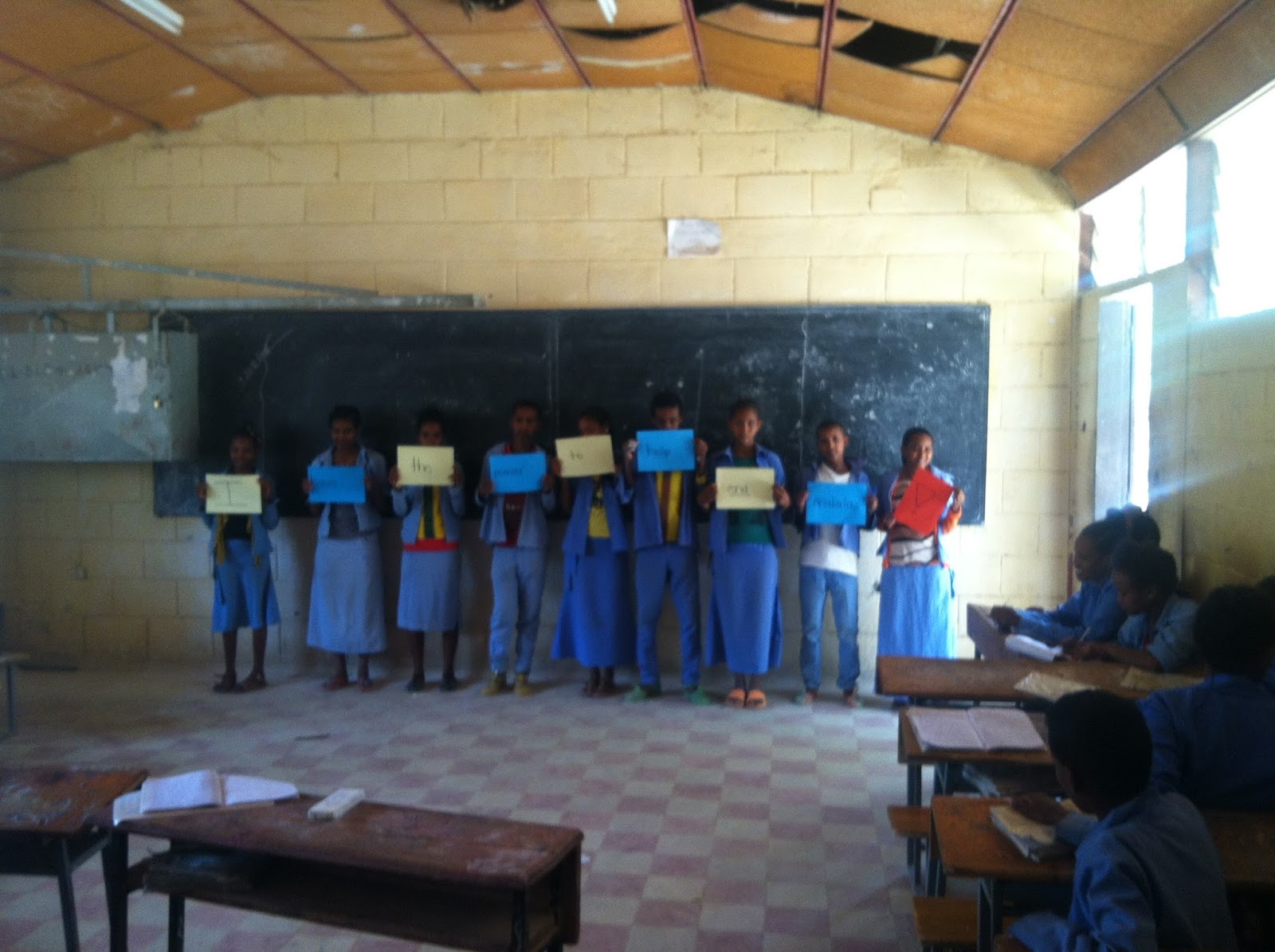
My biggest undertaking was trying to make a video with my students. I teach 4 sections of 10th graders. They love having their pictures taken sometimes, but other times they are super camera shy. I wanted to record some of them reading malaria facts and take pictures of them holding statistics, however this proved difficult. I knew they would be shy if I asked them to record in front of their classes, so I found random students during their break time (hence, why if you watch the video you can hear lots of noise in the background). My camera isn’t the best quality and my students are complete goofballs. I am sure if I had tried and really rehearsed I could have gotten some much better videos, but I decided I like what I have because it shows Ethiopian teenagers with their true personalities, good and bad. I ended up putting together a video with a student reading a malaria “fact”, a slide of the fact that was read, a picture of a student holding a malaria statistic, a slide of the sentence that was in the picture, and then a repeat with the others. I showed them the video when it was done, and like all videos in class it was challenging with so many of them and my computer screen and speakers being little, but they really enjoyed listening to/watching their classmates and themselves.


The last thing I did for malaria month was “public service announcements” with my students reading a few little sentences each day about malaria at the flag ceremony. What it is, how to prevent it, how to test for it, and then how to cure it. I approached some of my students I knew would be able to read them, but when they learned I wanted them to read it in front of their shift they got very nervous and many declined (A shift has about 670 students). Only a few of my students were willing to read them and it was difficult to find a day at flag ceremony where there were no other announcements or programs. Wednesday was the day! 3 of my 4 students read their paragraphs for their shift, and did an amazing job. They read well, smoothly, clearly, and their tone was just right. I’m so proud of them!

Every volunteer is different in how they approach these International days and months. There seems to be one for everything, from gender equality, to lots of health and environment things. I did a program for International Day of the Girl, but haven’t done much since then. Many of my fellow volunteers really enjoy running programs and are able to conduct them with the help of counterparts, their schools, or their communities. I have had a more difficult time getting things going, but this was an easy enough subject to incorporate into my own classroom and conduct programs on my own, without a lot of outside help and motivation.


Sometimes I feel like I’m not doing much over here, like I’m a bit of a fail, especially when I hear/see what my fellow volunteers are doing in Ethiopia and around the world. But then I have the success of one little classroom competition, or having teachers asking me for bed nets to take home, and something like World Malaria Month takes on more for me than just educating about malaria and everything that comes with that, it becomes about community development and involvement, leadership, integration, and education.

Thursday, March 10, 2016

Why Sweat The Small Stuff?

My life this past week has been a stressful one. I tend to over think and worry about things a little too much, and in my head every scenario ends up in the worst possible case, even though that’s never actually happened in my life. My Peace Corps group was able to sign up for our COS date (aka, when we officially become a Returned Peace Corps Volunteer and peace out of Ethiopia), which caused a flurry of choosing the first spots to get back to America for various reasons. This also prompted my 24-hour meltdown in which I realized I still have a lot of unknowns in my future.
            Up until this point in my service my group has talked about life after PC with a sense of fantasy, like it’s something so far away it’s not real. Well, with the release of that email and grad school and job acceptances for myself and others, it’s becoming a much more realistic and slightly terrifying reality. I had a few close to breaking moments as I was beginning to realize I am still playing the waiting game and there are still many uncertainties after 5 months. I like having a plan, I have a to-do list every day, and I have always known what I wanted to do next. I think this is why the past few days have been so stressful for me. Not because what I’m dealing with is this stressful, but because I don’t handle the unknown in a very calm way.
            To add to that, site has been a bit of a struggle with my students hitting their “senioritis” a bit early (they have about 2 months of class until they take their National Exams), verbal harassment from kids having gone up with the arrival of 2 new Korean volunteers and a large group of Chinese construction workers, and the all-important arrival of hot season, which makes any day between the hours of around 10am and 6pm absolutely miserable. I now understand why Ethiopian women use their umbrellas during sun and rain! The Ethiotel network has been in and out like crazy recently, so texts sometimes get sent but no one has been able to make a phone call go through in days, which makes the stress of everything worse when you can’t even call your best friends and support system in country. I’m also attempting to get back into shape, which means exercising and eating healthier, which I’m super will make me feel better soon, but for now I just want all the unhealthy food I can’t have.
            However, I am reminded every day that the struggles I face are more built up in my head than are actual problems, and that I need to be grateful for the time left that I have here.
I was walking down the street the other day when I heard a huge gasp. I turned to my right and the little toddler with Down Syndrome who is always at the firenji mart was sitting with (I think her dad…) on the front porch of a restaurant I frequent (the same family owns the store and the restaurant). She recognized me walking on the street, and when her dad put her on the ground she ran up to me, gave me a giant hug around the legs, and pulled me down to give me a kiss on the cheek. All the Ethiopians around watched in amazement, as this little girl got so excited to see me, and laughed when I got just as excited to see her. Her smile every time she sees me makes me happy and helps me remember that I’m loved, because she shows her admiration in such a way that it shows with a huge smile and twinkling eyes.
            As mentioned above, teaching has been getting difficult with my students pretty much checked out. At this point, most of their classes are review and I’m the same way with my textbook and lessons. One of my more spirited students the other day kept calling me “Mr. Kelsey.” I took that as an opportunity to teach them the difference between Mr. and Miss/Ms./Mrs. (male versus female). Since that day they have had a quiz and a group work assignment and on both papers that student has written, “set by Mr. ____________________.” The fact he took that and has started to call me Ms. Kelsey as well as call himself Mr. reminds me that even if they don’t always remember the textbook English I teach them, at least I am teaching them random little lessons that will hopefully help them in the future.
            There are a few new TV channels that are on point (in my opinion). They show music videos, but unlike some of the other channels that are constant Tigrinya (they all sound the same) or Amharic (there is more of a variety there), it’s a mixture of all Ethiopia, Indian, Western, and other countries. It can change between a Gurage (Southern Ethiopian) song, One Direction, an Indian song, and then a song from Nigeria. This has provided a lot of entertainment and prompted some serious dance parties in my teachers lounge and buna bet’s around town. It’s hilarious to watch Ethiopian adults try to dance to Ariana Grande, just as they probably find it even funnier to watch me try to move my hands and head like Southern Ethiopians do with their fast paced dance music.
            People tend to move compounds frequently here. Unlike in the US where you buy or rent a house for a long period of time, I have noticed families tend to drift between houses and compounds. My compound has quite a few families, and because of the community sense here, I’m honestly not entirely sure which of the kids I see wandering around actually lives with me, and which are just constantly over. One of the little girls who I became pretty close to moved when I was home over the summer, and even though she came to visit I was sad she left. However, she moved back to my compound this week and it’s been non-stop giggles ever since. Yesterday after I was exhausted from teaching she came into my room, but instead of demanding I do something with her, she quietly started looking at a magazine I recently got in a care package, then took out my coloring utensils and a coloring book and started coloring quietly. Soon the other compound kids discovered where she was and my calm was disturbed by them rummaging to find crayons, coloring books, and stickers. However, that was accompanied by laughter and smiles as they played with my hair, attempted to braid it, colored Disney and Pooh, and stuck stickers on my face and theirs before attempting to take selfies on my iPhone, while failing in the cutest ways.
            I was sitting in my room with the door and window open a few evenings ago to let the breeze in (when the sun goes down, the weather is perfect) and I heard a familiar sound of a child’s voice and pitter patter of feet. My compound niece and her dad dropped in for a visit and some sewa. I was invited out as well, and we sat around with sewa, laughing, and drinking. Although I never understand what’s being said at these gatherings I love feeling a part of their family and the community. Meerin (the toddler) started getting tired and fussy, so the adults started making random noises with their mouths, the tarps, and the trees around to distract her. She started joining in the fun and soon we had a symphony of ghost, lion, hyena, dog, cat, and just loud noises going on. They continued until she got too tired and fell asleep sucking her thumb nestled on her dads lap as he finished his sewa before picking her up, laying her on his shoulder, and walking home. It melts my heart to see parents caring for their children anywhere, especially when it’s a father caring for his daughter. I see women caring for their children and carrying them everyday on the street, so to see a large guy take such good care of someone so little reminds me how important parents are. Seeing sweet moments like that remind me of how precious being a parent must be, and how important that relationship is, as well as how much I miss my own.
            I have realized in the past few weeks how my best friends at site are the toddlers around town, and my land family. Back in the States I hung out with people my own age, but here it’s much easier to hang out with those older and younger. They see the world in a different light and they help me to understand humanity better. I have gotten myself all stressed out about life after here. But then I have one of those moments mentioned above, or many others in between and I have to smile to myself and remember that these are the moments I will miss the most when I leave. Time has flown by, when looking back, although regular days seem to drag on. The group before me is starting to leave country and the newest group gets sworn in, in about 3 weeks. I only have about 2 months of teaching left and about 5 months left in country. If I don’t leave early for grad school, I leave Ethiopia on August 26.
            I might be super stressed; I might have “I want to break down, Ethiopia won”, kind of days. I might want this experience to just be over now. But I’m shown constantly that I need to take in every moment and let every minute here be a blessing, because I will look back and wish I could relive some of those feelings. Jessie called me the other day (when our phones actually connected—the network has been really off this past week) to tell me there is a camel in the well in her town. Yes, you read that correctly, there is a camel in the well. I guess the owners couldn’t afford to take care of it, so they blinded it and it somehow ended up in the well. This was on Wednesday and she jokingly said, “Worst Hump Day ever,” which I found absolutely hysterical. We all have been stressed this past week, but as I’m now reminded, don’t let the “camel in the well” days get you down, the next day will be better.

One of my Chi Omega sisters Allison recently quit her job as a nurse to travel the world. I see her pictures and hear her stories and am reminded that life really is short, and that it’s YOUR life. So you can’t wait around and worry, you can’t sit and wait for something to happen. YOU have to do something about it, whether it’s book a ticket across the globe, kick kids out of class to make things easier for you and the other students, or promise to not panic about what you are doing in 5 months. So why sweat the small stuff? In a few months this will all be a memory, those people who have taught you so much will just be in your mind and pictures, and the moments you took for granted now just turn into stories.

Tuesday, March 1, 2016

Highlighting Happiness

Every year to celebrate it’s birthday, Peace Corps has their Peace Corps week where they celebrate all things Peace Corps with a theme. This year the theme is “Highlighting Happiness: What Does Joy Look Like in My Peace Corps Country?” I was going to write a blog about my own happiness here, and I might do that later in the week. But today my blog has a special focus on happiness from the perspective of my students.

I gave a quiz last week to review the Unit we just finished in the textbook. Normally when I give quizzes it is 10 multiple choice questions and then 2 bonus questions, with each one being a multiple choice question worth half a point. However, this week one of my bonus questions was “When are you happiest?” with the sentence prompt, “I am happy when ________________.” I even gave an example of “I am happy when I am drinking buna with my family.”

When I collected the papers and read the sentences later it showed both the creativity of some of my students, and yet how prevalent cheating is. There were 3 or 4 sentences in each class that were written by 1 student and then written the exact same way by about 10 of their friends and classmates. I am well aware of the cheating here, which is one of the reasons I don’t give quizzes often. It was interesting to really see which groups sit together though by that final answer. However, that’s another issue for another discussion- back to happiness.

I collected the answers from my classes and here is the list I received. I know they are happy much of the time, for many different reasons. But here are some of the times Ethiopian teenagers are happy:
I am happy when…

T-13
-       I am listening to music
-       I help my sisters
-       I am drinking tea with my family
-       I come to school
-       I make buna
-       I play football
-       I am visiting a historical place
-       I am drinking coffee
-       I go to school every day
-       I am making cloking with my sister
-       I am reading a book with my friend
-       I am playing football with my friends
-       I am making injira with my mother
-       I am with my father
-       I am with my friends
T-14
-       I play football
-       I am drinking tea with my family
-       I am drinking coffee with my friend
-       I wear a new dress
-       I am laughing with my family
-       I watch TV or a film
-       I play pool
-       I play volleyball with my friend
-       I am drinking beer with my sister
-       I get good marks
T-15
-       I listen to music
-       I dance
-       I play football
-       I pass my exam
-       I am drinking tea with my family
-       You are happy
-       I am drinking buna
-       I am drinking sewa with my brother
-       Kelsey is happy
T-16
-       I am studying English
-       I am going to school with friends
-       I am drinking tej
-       I am playing volleyball with my friend
-       I am living with my family
-       I am going to Adwa
-       I am listening to music with my friends
-       I am visiting historical places with my friend
-       I am playing football with friends
-       I am doing homework
-       I am watching a film in my home
-       I am doing homework with my friend
-       I am meeting my brother
-       I am drinking Mirinda with my father
-       I am drinking tela
-       I am eating injira
-       I am playing football with my brother
-       Studying Biology
-       Listening to music
-       I am drinking milk with my sister
-       I am drinking tea with my family
-       I am going to Axum with my father


So whether you are happy when you play sports, hang out with your family, watch TV, listen to music, drink numerous alcoholic and non-alcoholic drinks, or when you pass your exams you might be more similar to an Ethiopian than you think. Happiness comes in all forms and it crosses cultures, ages, backgrounds, gender, and every other divide you can think of. Happiness and joy are universal, and we would do quite well to remember that.

Wednesday, February 24, 2016

Life Lessons From A Toddler

Recently my land niece has been spending a lot of time in my compound. Her mom got a new job, so she has been at our house and in my compound every day for the past about week and most of the evenings until one of her parents comes to fetch her. The sense of community is such that everyone in the compound watches out for her, not just her blood family, although she tends to entertain herself or play with the other toddlers and babies that live in my extended compound. I teach morning shift this week, so I leave before she gets to my house, but when I come home after class she has been here with a smile on her face when I walk through the door and then proceeds to keep me company both in my room and when I am inevitably invited out to buna, sewa, and/or food by the adults in my compound.

I have come to discover that entertaining toddlers for more than about 30 minutes is exhausting (shout out to all the parents out there!), but I have also come to learn some valuable life lessons from this 2.5 year old. And I think in all honesty, we could all use a little education from the children of the world.


Patience: As the saying goes, “Patience is a virtue.” Well, that’s something I learn everyday over here, and not just from Meeran. I learn it everyday from my students, to strangers on the street, to dealing with iffy network, power, and water. But toddlers tend to try your patience more than most. They don’t understand social and body cues that adults catch, which means that unless you are very strict with them, they will continue their behavior, and even then they might not listen. She loves playing with my Ethiopian phone and iPhone and looking at pictures, which keeps her entertained, until she tries to delete things without realizing or meaning to. When I try to take it away from her, she begins to cry. Not in a spoiled sort of way, but she just doesn’t understand. She will also stand outside my door repeating my name, which is adorable the first 10 times, but not so much when I’m actually trying to be productive. It’s the little things that might bug me, but continuously show me that patience is a virtue, and remind me to breath in and out.

Persistence: As I said in the above paragraph, this little one has some persistence. I don’t think she means to, it’s just in her brain to continue whatever she enjoys doing, which she doesn’t realize can interfere with how “grown ups” are running their lives. However, she has shown me that persistence really can work. Whether someone gives in just because they get so annoyed they want you to stop, or whether someone realizes how passionate you are about something, persistence can help you achieve a goal—whether it’s something like scheduling a meeting with someone, wanting to view pictures on a phone, or getting help on a project, or many other things in life.

Curiosity: I remember when I was younger wanting to learn all about the world. Although I was never a super out-doorsy child I did walk around and point to every living thing at one point and ask what it was. I know the big question adults’ dread is when their kids reach the age of “Why?” Children ask that all the time, but I think as adults we need to have the same curiosity. Children ask because they genuinely want to learn about the world around them, not necessarily for some big and important meaning like adults tend to. But when they show that curiosity, they begin to understand how and why things work and happen and can apply that to their lives. Toddlers ask “Why?” and “What?” a lot more than adults. As we grow up we might still have the same curiousity but not voice it because we afraid we are too annoying to someone else, but children don’t have that worry. Meeran asks me this constantly, and I can’t answer because I don’t speak Tigrinya well enough. But hearing her ask me that every 5 seconds reminds me that curiosity about the world and life is something that I should have more of, because there is so much to learn and try to understand.

Comfort: Children tend to give comfort without even realizing it. They have such an innocence about them, that when you need a smile, they can give you one without shedding their own. On many of the days I have been greeted by the smile of a toddler or child on the street or in my house it’s been a day where I have been wearing a frown of frustration or sadness. I might have had a long day, but the simple act of having a toddler sit on your lap, make faces at you, or give you a hug can be enough to make you smile from ear to ear and leave you going to sleep happier than a few hours before. This is also shown by the love of her mom and dad, her aunt, and the multitude of other adults that watch over her. Whenever she gets down and starts to cry, they are right there to pick her up, rock her, and get her to stop crying by comfort or humor. She doesn’t realize yet how important those relationships are, but they are something I crave now that I am older. We could all use toddlers as an example of how to comfort someone who is having a hard time—not by crawling into their laps or even through physical contact (although a hug can be extremely helpful), but sometimes a kind word or even something as simple as a smile is the comfort a friend, family member, or stranger on the street needs.

Love: Love is a word that is used a lot for many different relationships. I have come to learn that love is something you feel for someone else when they are there for you through everything, no matter the time or distance. Ethiopian communities are full of love, and so are children around the world. Nothing makes me happier than seeing the bond of family while here, especially missing my own family so much. And I think Meeran shows love more than most. The younger you are, the more you show and feel love, the more you wear your heart on your sleeve, and the more you let love win over anger and hate. I can feel the love she has for her parents, her aunts, her uncles, and me whenever she smiles, whenever she hugs me or them, and whenever she whispers “I love you” like her parents have taught her to say. I don’t think you need to “love” everyone around you, but I think the world would be a much happier place if everyone decided that they deserve love and are capable of it. Then take that and show the people around them their feelings, because even though showing your love without any wall is difficult and puts you in a place of vulnerability, I think the world needs more unconditional love, which is what toddlers and children show every day.

Joy: Joy is a human emotion that spans every age, gender, race, and location in the world. I think joy is just shown more by children, because they tend to find even the smallest things full of fun and happiness. Children here will play with a tire or a piece of wire for hours on end and smile just as much as when they started. Meeran laughs and smiles at absolutely everything and I can just tell that she is enjoying the world around her much more than the adults surrounding her at buna, including myself. I have been trying to find the little things that make me happy recently instead of concentrating on the hardships, and spending so much time with children has helped that, because they find almost everything to be fun and full of joy. I’m not saying they are happy all the time, because Meeran cries quite often, but she bounces back as soon as I start making a funny face at her, or until her mom hugs her. She played for hours with a punch balloon I brought back from the States, and her joy was evident on her face. I think we all need to take a page from Meeran and other kids and remember to find joy in the little things, because happiness is all around us.


I try not to watch the news, even when I get the opportunity, because it just makes me sad. Seeing so many stories of adults who hurt others on purpose make me wonder what happened to them in the past to tell them it is ok to think like that. As Nelson Mandela once said, “I always knew that deep down in every human heart, there is mercy and generosity. No one is born hating another person because of the color of his skin, or his background, or his religion. People must learn to hate, and if they can learn to hate, they can be taught to love, for love comes more naturally to the human heart than its opposite… Man’s goodness is a flame that can be hidden but never extinguished.” And I believe that to be true, even with everything awful that is happening in the world. Children are innocent, but I think they also understand more about treating each other with kindness and love, and as we grow older we begin to forget that.

I have spent a great deal of time with children in the States teaching them and here with the children in my community, and I have come to learn more about life, the world around me, and how to treat others through watching them interact with each other and the world as a whole. Children, especially toddlers approach life with a curiosity, a passion, unconditional love, acceptance, and joy that I think we all could take a lesson from to apply to our own lives. Only by reverting back to some of what we valued in childhood can I think our world become a better place.


Thursday, February 18, 2016

My Why...

           When I tell people I am part of the Peace Corps I get a variety of responses. They range from, “What’s the Peace Corps?”, “Oh hey, I served in the Peace Corps too!” (This tends to lead to a very long PC lengthy discussion about our services), to “I wanted to do that and then life happened”, “Tell me about it, I’m thinking about doing something like that”, to “That’s so cool!”, but the most common one is a single word, “Why?”
            I began to get really annoyed with it, until I realized I didn’t always know the answer to that word myself, and then I began to self-doubt myself. Why did I decide to move across the world, give up everything I was familiar with, leave my home that I have lived in for 22 years and my friends and family, and start my life in a new and very different place, teaching kids 10 years older than what I’m used to, adjusting to brand new food, language, and over all way of life with people I am not sure whether I will like or not. When you think about it like that, you probably think I’m crazy, and I began to think that as well.
            Before I came I thought about my reasoning a little bit, but having visited home and having to answer that question a lot more, I began to self-reflect about my decision and the experiences I have had so far to answer that one word, “Why?”
            Everyone in my group, in Peace Corps, and in general people that travel all have their reasoning’s. So here is mine: I want to leave the world a better place than how I joined it, I want to change people’s lives, and I want to experience the world in a deeper way than just viewing it from the outside.
I am not going to say that me coming in and teaching for 2 years is making the world a better place, that would be way too self-righteous and would give myself and organizations like Peace Corps too much credit. Yes, there are ways in which I think Ethiopia could develop and become more effective, but in no way is the way I think better than the way they think. My community functions and has many things that I wish my community in America could learn from. I merely think that if I can help even one of my students realize their abilities and worth, help my neighbors improve their English to enhance their job getting abilities to support their families, or even just spread awareness of America and what it’s really like to Ethiopians, than I am improving the world, even if it’s a tiny ripple.
            I am a teacher, which means I automatically change people’s lives because of the nature of my work. Education is a personal thing to people, and most people have many stories both good and bad about their education and specific teachers, whether they changed their lives for the better or worse, all educators have the ability to touch their students’ lives. I just decided I wanted to touch lives in a place unfamiliar to myself. To get myself out of my comfort zone and see what else is out there. Since being here that passion has grown to really extend to my female students and helping them realize their full potential in a country with many gender equality issues still in place.
            When I grew up everyone around me also grew up in New Mexico (for the most part). Not that that’s a bad thing, New Mexico is a beautiful place. But I never felt like I truly belonged there, I have always wanted to travel and see the world. Recently my PCV friends and I had a hilarious discussion about what we would do if we won the massive Powerball lottery. While most people would buy houses or cars, we all wanted to travel. My life goal is to fill passports with stamps. I do want to settle down and have a house and a dog and kids and a husband and all that jazz, but that doesn’t mean I can’t experience and explore the world. That being said, I wanted to experience the world outside of “the tourist” mentality, outside of hotels and recommended restaurants, outside of relaxing and easy tourism. I wanted to experience a different culture and world from inside, being able to tell funny and sad anecdotes from the people themselves, not just see an attraction and eat some food and pretend I know the place when I leave on a plane.
            I still don’t have a clear and concise answer to those that ask me this question. My answer tends to change with the day I have had, what mood I’m in, and how philosophical I’m feeling. But I do know that my idea of experiencing the world, learning about myself, and touching people’s lives will always hold true. I will probably change my answer continuously, especially when I get home, as my full service will be done and I can bring what I learned from there.

            I have found it challenging but rewarding to have to answer that question of why I am doing this. On my hard and frustrating days, which have been a lot closer and more frequent recently, I have to remind myself why I am in fact doing this. So on the days where you want to give up what you are doing, whether that be a job, a hobby, or a relationship with someone I want you to think to yourself, “Why am I doing this?” and remind yourself why you started that in the first place. There were obvious benefits, or else you would not have gotten yourself into it, so remind yourself of those so that you can continue on your journey to get the most out of the experience, because sometimes the answer of “Why?” is the most important part of your strength and conviction.

Monday, February 1, 2016

Dear Chi Omega

Dear Chi Omega,

            Thank you for imparting on me role models to look up to. I have always had strong female leaders in my life, in my family, parents friends, teachers and my own friends, but Chi Omega has given me a chance to really find people my own age (and younger) to guide me. I have been helped by their actions, words, and character. My sisters have shown me how to be strong, how to be true to yourself, how to help others, how to be kind, and how to be selfless. They have helped guide me to be my own person, to love unconditionally, to be a pillar of support for others, to be a role model for everyone around me, and they have helped me feel like I am special to someone.

            Thank you for confirming for me how I am an important part of something so much bigger than myself. Sometimes I can feel like my life is insignificant and that I am not making an impact. Sometimes life gets you down and you don’t know why you continue to work hard with no results. Chi Omega taught me that no matter the difference you are making, no matter how small you may seem, you are a part of something much larger than yourself and you are important.


            Thank you for showing me how relationships are meant to be maintained, and how significant they can be in life. I have met so many amazing women as a part of an active member of Pi Gamma, and Chi Omega as a whole. I have a random mix of friends as a result, from my sisters to my fellow Greeks. I have become close to many of them through shared interests, random moments, and both tragedy and triumph. I have had a hard time maintaining some of these relationships across the world, while others have become stronger. There have been ties that have been cut, I have been hurt by some of the people closest to me, and it’s been a difficult road for some of us. However, through all of that, I have come to realize that some people can’t belong in your life, but those that stick it out and support you no matter what are the friendships to hold onto. Even those who can’t stay in your life have helped build you up, even through those tests. The friendships that you form in your life will help you become the person you are, and will hold strength for you. Your friends and sisters will be there for you and help you grow, flourish, and become a much better person than you thought you could ever be.

            Thank you for aiding me in realizing how important lessons are to learn, both good and bad. Times can get tough and not every moment is going to be happy. But no matter what happens, it happens for a reason. Even in the hardest times, lessons are being learned and you are growing as a person. In the happy moments, those also help you grow as a person, but in a different way. Both times and memories are meant to help you flourish and become a better women than you were before. Chi Omega showed me how to take those lessons and moments of trial and triumph and help them mold me into a stronger woman.


            Thank you for expressing to me that no matter what, the people I share ideals with will help me on my path in life. I have sisters that share the same principles and they want the same things from life, but I also have those that differ in a lot of ways. Our common bond however is that we are a part of Chi Omega. I have also found solace in men and women from other Greek organizations. Our bond may not be that we are a part of the same organization, but we all are working towards something bigger than ourselves, and with that knowledge we are able to make friendships in a system that helps us grow as people.


            Thank you for giving me memories that will last a lifetime. From the random late night food runs to study sessions, from crying on shoulders from sadness to laughing until you cry, Chi Omega gave me some of the best moments in my college life and in turn in my life in general. I have so many pictures that capture the good times, but so many more in my head that have helped me when I’m feeling down. The good, great, fun, and amazing times I had with my sisters have helped me when I need a pick me up, because they remind me that life really is great, and I am so blessed to be a part of this organization. The little moments and things are the ones that stick with you the most. Whether it’s a kind smile from a sister, a word of encouragement, a “thank you” from someone, laughing on the red couch, late night Zimmerman study times, or Greek Week wins, those are the most significant times, and I’m learning that more than ever in Peace Corps—to take the small moments because they will become the defining time of your life and your experiences.


            Thank you for helping me feel at home, no matter where in the world I am. When I was in college I didn’t want to feel like 1 person in thousands, as my university was so much bigger than my high school. When I joined Chi Omega, I came into a family and I felt right at home at 1810 Mesa Vista Rd. When I graduated and moved across the world, I felt isolated and alone a lot. But I found a home in the Symphony I look at every morning, the pictures on my wall from my time in the house, the words of support and encouragement online from my sisters back home, the support of a fellow Chi Omega in my Peace Corps group, and the knowledge that I still belong to this great sisterhood, even across the world.


            Thank you for revealing to me that my stubbornness in not wanting to go through recruitment and then not wanting to follow my family was stupid. I was hoping to not like Chi Omega, so I could be my own person, but after pref night and how I felt, I knew Chi Omega was the place for me, and I’m so right. Although I have grown, made friends, traveled, explored, and learned outside of Chi Omega, that really helped me become the person I am today. I would not be in Ethiopia, I would not be as outgoing, thoughtful, or kind as I am if it weren’t for my membership in Chi Omega.


            Chi Omega has helped me in more ways than I can ever express in words, but between it’s ideals, it’s membership, and the sisters I have met along the way, it deserves a little recognition. To all my sisters who have helped me from near and far, both in huge ways and in the small moments, thank you.